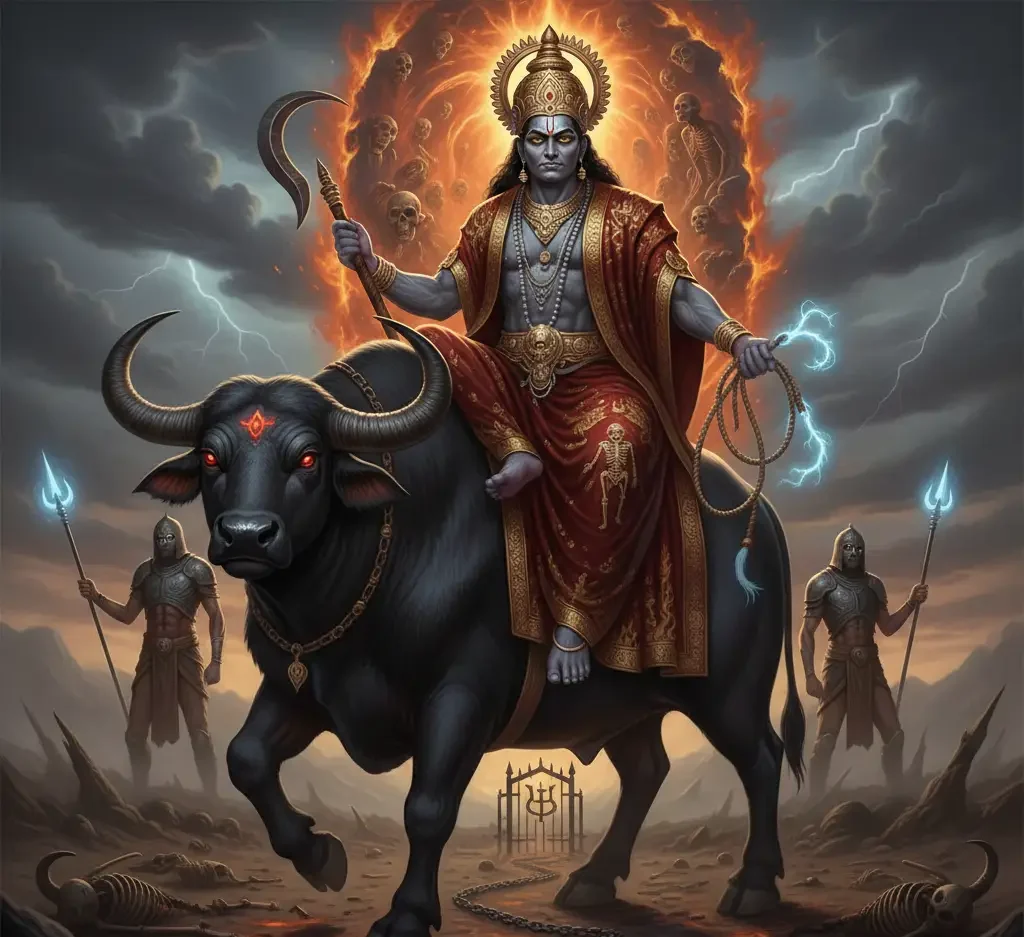
Lord Yamraj: The God of Death, Justice, and Karma in Hinduism
Lord Yamraj, also known as Yama, Dharmaraj, or Yamadev, is one of the most powerful and respected deities in Hinduism. He is widely known as the God of Death, but his role is far deeper than merely taking lives. Yamraj is the divine authority of justice, karma, and moral law (Dharma). He decides the fate of every soul after death based on their actions (karma) performed during life. Because of this, Yamraj occupies a unique and essential position in Sanatan Dharma.
In Hindu philosophy, death is not considered the end but a transition of the soul from one body to another. Lord Yamraj governs this transition with fairness and cosmic order. He ensures that the universal law of karma is upheld and that no soul escapes the consequences of its deeds.
Origin and Mythological Background of Yamraj
According to Hindu scriptures, Lord Yamraj is the son of Surya Dev (the Sun God) and Sanjna (Saranyu). He is the twin brother of Yamuna, the sacred river goddess. This divine lineage highlights Yamraj’s role as a cosmic authority rather than a fearsome figure alone.
The Vedas, especially the Rigveda, mention Yama as the first mortal who discovered the path of death and became the ruler of the departed souls. Because he was the first to die, he became the guide for all souls who leave the physical world. Over time, Puranic literature expanded his role as the supreme judge of the dead.
Yamraj as Dharmaraj – The Supreme Judge
One of the most important names of Yamraj is Dharmaraj, meaning “King of Dharma.” This title signifies his role as the ultimate judge who delivers justice impartially. Yamraj does not act based on emotions, favoritism, or devotion alone; he judges purely on the basis of karma.
Every action—good or bad—performed by a human being is recorded by Chitragupta, Yamraj’s divine accountant. These records are presented in Yamraj’s court after death. Based on this detailed account, Yamraj decides whether the soul will experience punishment, rewards, or rebirth.
This concept reinforces a powerful moral teaching: no deed goes unnoticed, and everyone is accountable for their actions.
The Court of Yamraj
The court of Yamraj is described vividly in the Garuda Purana and other scriptures. It is said to be located in Yamlok, a divine realm beyond the physical world. Souls are brought to this court by Yamraj’s messengers, known as the Yamadutas.
In this court:
Chitragupta reads the detailed karmic record of the soul
Yamraj listens carefully and gives judgment
Justice is delivered according to Dharma
The purpose of this court is not cruelty but cosmic balance. Punishments are meant for purification, while rewards are given to uplift the soul.
Symbolism of Yamraj’s Appearance
Lord Yamraj is often depicted with a dark complexion, riding a buffalo, and holding a noose (Pasha) in his hand. Each element of this depiction has deep symbolic meaning:
Buffalo: Represents ignorance and inertia, which Yamraj controls
Noose (Pasha): Symbolizes the binding nature of karma
Dark complexion: Represents the unknown nature of death
Despite his fearsome appearance, Yamraj is not evil. His form reminds humans of the inevitability of death and the importance of righteous living.
Yamraj in Major Hindu Scriptures
Yamraj in the Vedas
The Rigveda describes Yama as a divine king who
# Lord Yamraj: The God of Death, Justice, and Karma in Hinduism
Lord Yamraj, also known as **Yama**, **Dharmaraj**, or **Yamadev**, is one of the most powerful and respected deities in Hinduism. He is widely known as the **God of Death**, but his role is far deeper than merely taking lives. Yamraj is the divine authority of **justice, karma, and moral law (Dharma)**. He decides the fate of every soul after death based on their actions (karma) performed during life. Because of this, Yamraj occupies a unique and essential position in Sanatan Dharma.
In Hindu philosophy, death is not considered the end but a transition of the soul from one body to another. Lord Yamraj governs this transition with fairness and cosmic order. He ensures that the universal law of karma is upheld and that no soul escapes the consequences of its deeds.
—
## Origin and Mythological Background of Yamraj
According to Hindu scriptures, Lord Yamraj is the **son of Surya Dev (the Sun God)** and **Sanjna (Saranyu)**. He is the twin brother of **Yamuna**, the sacred river goddess. This divine lineage highlights Yamraj’s role as a cosmic authority rather than a fearsome figure alone.
The **Vedas**, especially the **Rigveda**, mention Yama as the **first mortal** who discovered the path of death and became the ruler of the departed souls. Because he was the first to die, he became the guide for all souls who leave the physical world. Over time, Puranic literature expanded his role as the supreme judge of the dead.
—
## Yamraj as Dharmaraj – The Supreme Judge
One of the most important names of Yamraj is **Dharmaraj**, meaning “King of Dharma.” This title signifies his role as the **ultimate judge** who delivers justice impartially. Yamraj does not act based on emotions, favoritism, or devotion alone; he judges purely on the basis of **karma**.
Every action—good or bad—performed by a human being is recorded by **Chitragupta**, Yamraj’s divine accountant. These records are presented in Yamraj’s court after death. Based on this detailed account, Yamraj decides whether the soul will experience punishment, rewards, or rebirth.
This concept reinforces a powerful moral teaching: **no deed goes unnoticed**, and everyone is accountable for their actions.
—
## The Court of Yamraj
The court of Yamraj is described vividly in the **Garuda Purana** and other scriptures. It is said to be located in **Yamlok**, a divine realm beyond the physical world. Souls are brought to this court by Yamraj’s messengers, known as the **Yamadutas**.
In this court:
* **Chitragupta** reads the detailed karmic record of the soul
* Yamraj listens carefully and gives judgment
* Justice is delivered according to Dharma
The purpose of this court is not cruelty but **cosmic balance**. Punishments are meant for purification, while rewards are given to uplift the soul.
—
## Symbolism of Yamraj’s Appearance
Lord Yamraj is often depicted with a **dark complexion**, riding a **buffalo**, and holding a **noose (Pasha)** in his hand. Each element of this depiction has deep symbolic meaning:
* **Buffalo**: Represents ignorance and inertia, which Yamraj controls
* **Noose (Pasha)**: Symbolizes the binding nature of karma
* **Dark complexion**: Represents the unknown nature of death
Despite his fearsome appearance, Yamraj is not evil. His form reminds humans of the **inevitability of death** and the importance of righteous living.
—
## Yamraj in Major Hindu Scriptures
### Yamraj in the Vedas
The Rigveda describes Yama as a divine king who rules over the ancestors (Pitras). He is respected and invoked for guidance after death.
### Yamraj in the Mahabharata
In the Mahabharata, Yamraj plays a crucial role in the life of **Yudhishthira**, who is considered his spiritual son. Yudhishthira’s unwavering commitment to truth and Dharma reflects Yamraj’s values.
### Yamraj in the Garuda Purana
The Garuda Purana provides the most detailed description of Yamraj’s judgments, punishments, and the journey of the soul after death. It emphasizes moral living and fear of wrongdoing.
—
## Yamraj and the Law of Karma
The philosophy of **karma** is incomplete without Yamraj. He ensures that the results of actions are delivered accurately. Good deeds lead to positive outcomes such as heavenly experiences or favorable rebirths, while sinful actions result in suffering and correction.
This system is not based on punishment alone but on **learning and spiritual evolution**. Through Yamraj’s justice, the soul gradually moves toward liberation (moksha).
—
## Is Yamraj Worshipped?
Unlike other Hindu deities, Yamraj is **rarely worshipped directly**. However, he is respected and propitiated during specific rituals:
* **Pitru Paksha**: To honor ancestors and seek Yamraj’s blessings
* **Yama Dwitiya (Bhai Dooj)**: Celebrated to reduce fear of untimely death
* **Shraddha rituals**: For peace of departed souls
These practices highlight Yamraj’s role as a guardian of ancestral souls.
—
## Spiritual Lessons from Lord Yamraj
Lord Yamraj teaches humanity some of the most important life lessons:
1. **Life is temporary** – Death is inevitable
2. **Karma is permanent** – Actions shape destiny
3. **Dharma is supreme** – Righteousness leads to peace
4. **Justice is unavoidable** – Everyone is accountable
Remembering Yamraj encourages ethical living and spiritual awareness.
—
## Conclusion: The True Meaning of Yamraj
Lord Yamraj is not merely the God of Death; he is the **protector of cosmic order**, the **guardian of justice**, and the **enforcer of karma**. Fear arises only from ignorance. For the righteous, Yamraj is a fair judge and a guide toward spiritual progress.
By understanding Yamraj’s true nature, one realizes that death is not an end but a doorway to transformation. Living according to Dharma ensures that Yamraj’s judgment becomes a path of learning rather than suffering. Thus, Lord Yamraj stands as a timeless reminder that **truth, justice, and karma govern the universe**.
over the ancestors (Pitras). He is respected and invoked for guidance after death.
Yamraj in the Mahabharata
In the Mahabharata, Yamraj plays a crucial role in the life of Yudhishthira, who is considered his spiritual son. Yudhishthira’s unwavering commitment to truth and Dharma reflects Yamraj’s values.
Yamraj in the Garuda Purana
The Garuda Purana provides the most detailed description of Yamraj’s judgments, punishments, and the journey of the soul after death. It emphasizes moral living and fear of wrongdoing.
Yamraj and the Law of Karma
The philosophy of karma is incomplete without Yamraj. He ensures that the results of actions are delivered accurately. Good deeds lead to positive outcomes such as heavenly experiences or favorable rebirths, while sinful actions result in suffering and correction.
This system is not based on punishment alone but on learning and spiritual evolution. Through Yamraj’s justice, the soul gradually moves toward liberation (moksha).
Is Yamraj Worshipped?
Unlike other Hindu deities, Yamraj is rarely worshipped directly. However, he is respected and propitiated during specific rituals:
Pitru Paksha: To honor ancestors and seek Yamraj’s blessings
Yama Dwitiya (Bhai Dooj): Celebrated to reduce fear of untimely death
Shraddha rituals: For peace of
# Lord Yamraj: The God of Death, Justice, and Karma in Hinduism
Lord Yamraj, also known as **Yama**, **Dharmaraj**, or **Yamadev**, is one of the most powerful and respected deities in Hinduism. He is widely known as the **God of Death**, but his role is far deeper than merely taking lives. Yamraj is the divine authority of **justice, karma, and moral law (Dharma)**. He decides the fate of every soul after death based on their actions (karma) performed during life. Because of this, Yamraj occupies a unique and essential position in Sanatan Dharma.
In Hindu philosophy, death is not considered the end but a transition of the soul from one body to another. Lord Yamraj governs this transition with fairness and cosmic order. He ensures that the universal law of karma is upheld and that no soul escapes the consequences of its deeds.
—
## Origin and Mythological Background of Yamraj
According to Hindu scriptures, Lord Yamraj is the **son of Surya Dev (the Sun God)** and **Sanjna (Saranyu)**. He is the twin brother of **Yamuna**, the sacred river goddess. This divine lineage highlights Yamraj’s role as a cosmic authority rather than a fearsome figure alone.
The **Vedas**, especially the **Rigveda**, mention Yama as the **first mortal** who discovered the path of death and became the ruler of the departed souls. Because he was the first to die, he became the guide for all souls who leave the physical world. Over time, Puranic literature expanded his role as the supreme judge of the dead.
—
## Yamraj as Dharmaraj – The Supreme Judge
One of the most important names of Yamraj is **Dharmaraj**, meaning “King of Dharma.” This title signifies his role as the **ultimate judge** who delivers justice impartially. Yamraj does not act based on emotions, favoritism, or devotion alone; he judges purely on the basis of **karma**.
Every action—good or bad—performed by a human being is recorded by **Chitragupta**, Yamraj’s divine accountant. These records are presented in Yamraj’s court after death. Based on this detailed account, Yamraj decides whether the soul will experience punishment, rewards, or rebirth.
This concept reinforces a powerful moral teaching: **no deed goes unnoticed**, and everyone is accountable for their actions.
—
## The Court of Yamraj
The court of Yamraj is described vividly in the **Garuda Purana** and other scriptures. It is said to be located in **Yamlok**, a divine realm beyond the physical world. Souls are brought to this court by Yamraj’s messengers, known as the **Yamadutas**.
In this court:
* **Chitragupta** reads the detailed karmic record of the soul
* Yamraj listens carefully and gives judgment
* Justice is delivered according to DharmaThe purpose of this court is not cruelty but **cosmic balance**. Punishments are meant for purification, while rewards are given to uplift the soul.
—
## Symbolism of Yamraj’s Appearance
Lord Yamraj is often depicted with a **dark complexion**, riding a **buffalo**, and holding a **noose (Pasha)** in his hand. Each element of this depiction has deep symbolic meaning:
* **Buffalo**: Represents ignorance and inertia, which Yamraj controls
* **Noose (Pasha)**: Symbolizes the binding nature of karma
* **Dark complexion**: Represents the unknown nature of deathDespite his fearsome appearance, Yamraj is not evil. His form reminds humans of the **inevitability of death** and the importance of righteous living.
—
## Yamraj in Major Hindu Scriptures
### Yamraj in the Vedas
The Rigveda describes Yama as a divine king who rules over the ancestors (Pitras). He is respected and invoked for guidance after death.
### Yamraj in the Mahabharata
In the Mahabharata, Yamraj plays a crucial role in the life of **Yudhishthira**, who is considered his spiritual son. Yudhishthira’s unwavering commitment to truth and Dharma reflects Yamraj’s values.
### Yamraj in the Garuda Purana
The Garuda Purana provides the most detailed description of Yamraj’s judgments, punishments, and the journey of the soul after death. It emphasizes moral living and fear of wrongdoing.
—
## Yamraj and the Law of Karma
The philosophy of **karma** is incomplete without Yamraj. He ensures that the results of actions are delivered accurately. Good deeds lead to positive outcomes such as heavenly experiences or favorable rebirths, while sinful actions result in suffering and correction.
This system is not based on punishment alone but on **learning and spiritual evolution**. Through Yamraj’s justice, the soul gradually moves toward liberation (moksha).
—
## Is Yamraj Worshipped?
Unlike other Hindu deities, Yamraj is **rarely worshipped directly**. However, he is respected and propitiated during specific rituals:
* **Pitru Paksha**: To honor ancestors and seek Yamraj’s blessings
* **Yama Dwitiya (Bhai Dooj)**: Celebrated to reduce fear of untimely death
* **Shraddha rituals**: For peace of departed soulsThese practices highlight Yamraj’s role as a guardian of ancestral souls.
—
## Spiritual Lessons from Lord Yamraj
Lord Yamraj teaches humanity some of the most important life lessons:
1. **Life is temporary** – Death is inevitable
2. **Karma is permanent** – Actions shape destiny
3. **Dharma is supreme** – Righteousness leads to peace
4. **Justice is unavoidable** – Everyone is accountableRemembering Yamraj encourages ethical living and spiritual awareness.
—
## Conclusion: The True Meaning of Yamraj
Lord Yamraj is not merely the God of Death; he is the **protector of cosmic order**, the **guardian of justice**, and the **enforcer of karma**. Fear arises only from ignorance. For the righteous, Yamraj is a fair judge and a guide toward spiritual progress.
By understanding Yamraj’s true nature, one realizes that death is not an end but a doorway to transformation. Living according to Dharma ensures that Yamraj’s judgment becomes a path of learning rather than suffering. Thus, Lord Yamraj stands as a timeless reminder that **truth, justice, and karma govern the universe**.
departed souls
These practices highlight Yamraj’s role as a guardian of ancestral souls.
Spiritual Lessons from Lord Yamraj
Lord Yamraj teaches humanity some of the most important life lessons:
Life is temporary – Death is inevitable
Karma is permanent – Actions shape destiny
Dharma is supreme – Righteousness leads to peace
Justice is unavoidable – Everyone is accountable
Remembering Yamraj encourages ethical living and spiritual awareness.
Leave a Reply